
Recently I moved my Blitzortung lightning strike detector station to a new location. The location I selected is a pumphouse located around 40 meters (around 120 feet) away from any building. This pumphouse is served by buried cables providing electrical power and ethernet.
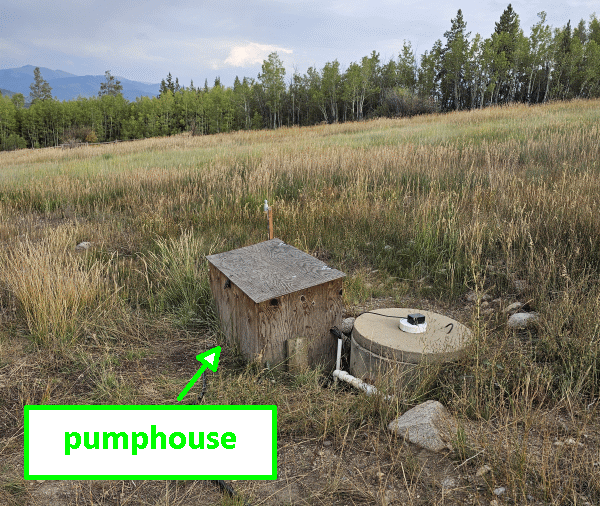
Here you can see a closer view of the pump house. Its roof is hinged and serves as a lid. The lid can be opened for access to the pump and other things inside the pump house.
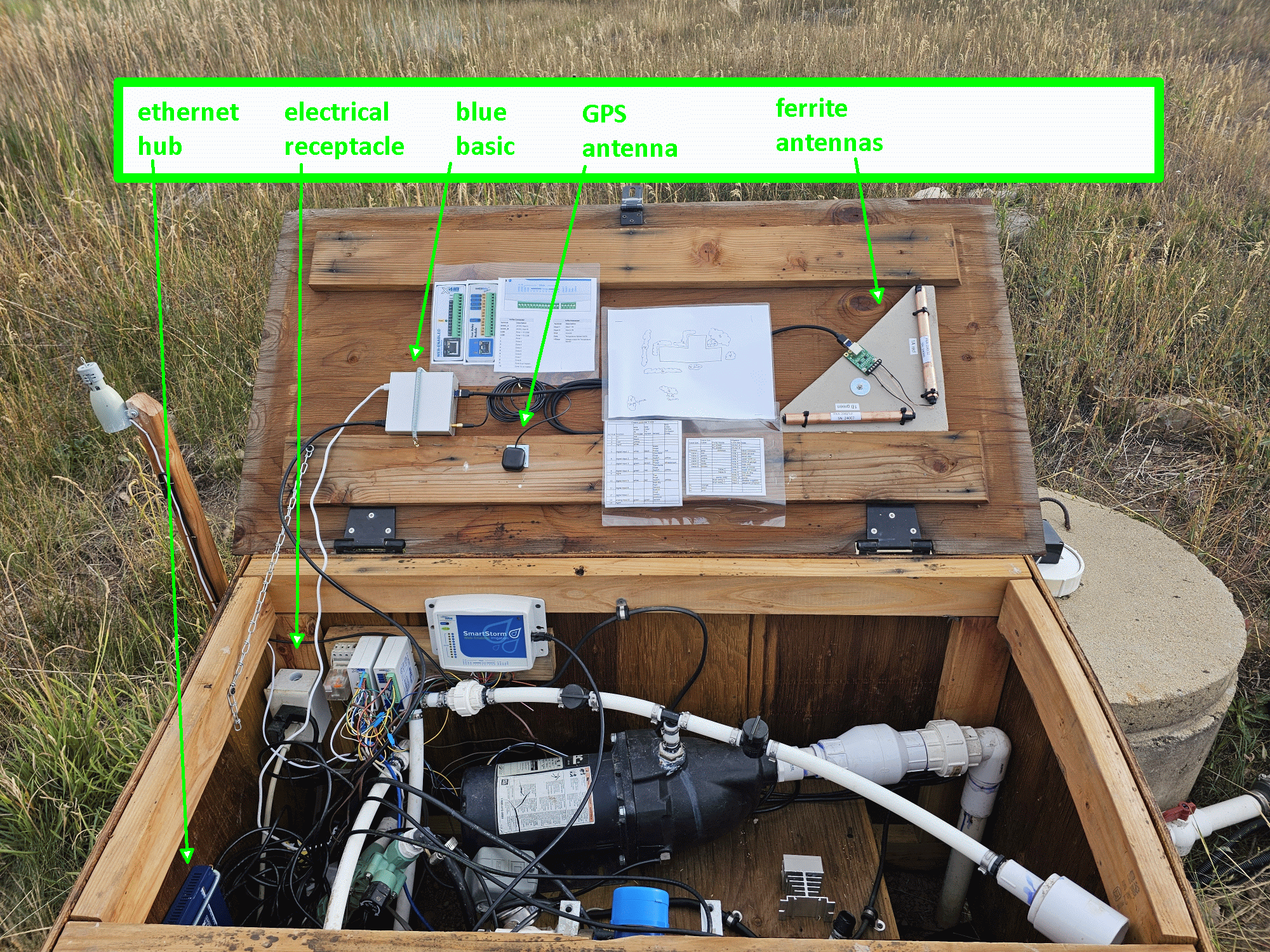
At the pump house, I chose to mount the blue mini and the GPS antenna and the ferrite-rod antennas to the underside of the lid. This keeps them out of harm’s way.
The alert reader already realizes my reason for picking this place to put the lightning detection station — it is far away from several nearby buildings each of which is full of rich sources of electromagnetic interference. Despite being far away from buildings, the location has electrical power and has a wired internet connection, both of which are important for the Blue mini station.
The alert reader might also get a glimpse of a ¾-horsepower electric motor powering a jet pump. It draws water from a nearby cistern and feeds it to an irrigation system. Perhaps this motor will interfere with lightning detection? And indeed the motor does raise the noise floor. When the pump is not running, the average noise in each of the two analog channels is around 15 mV. When the pump is running, one channel rises to around 19 mV and the other rises to around 50 mV.
The new beta-test firmware (version 11.0b3) for this blue mini has an “auto adapt to noise” feature that very nicely handles the few minutes of each day that the pump is on. I have posted a Youtube video showing this nice feature in action.