It’s time to get in your numbers for the 2025 toteboards

Hello readers.  It is now 2026 and this means it is time to get in your numbers for the 2025 toteboards:

The goal is to recognize and rank law firms in the US based upon the numbers of US design patents, US utility patents, US plant patents, and US trademark registrations each firm obtained for clients in 2025.

The questionnaires will close on Friday, February 13, 2026.

Here is a page suggesting how you might obtain these numbers.

Every year after I post the results of the toteboards, I get sad emails from firms that want me to accept their numbers late.  This would, of course, typically result in kicking other firms down in the rankings — other firms that got their numbers in on time.  Please help to reduce the number of such sad emails that I will receive this year.  Maybe you are a person at your firm who is responsible for getting these numbers in.  If so, please get your numbers in!  Otherwise, please forward this blog posting to somebody at your firm to make sure that somebody at your firm gets the numbers in for your firm.

You can see the previous toteboards here, going back to the earliest toteboard in 2012.

Should the listserv member click on the link? Is it spearphishing?

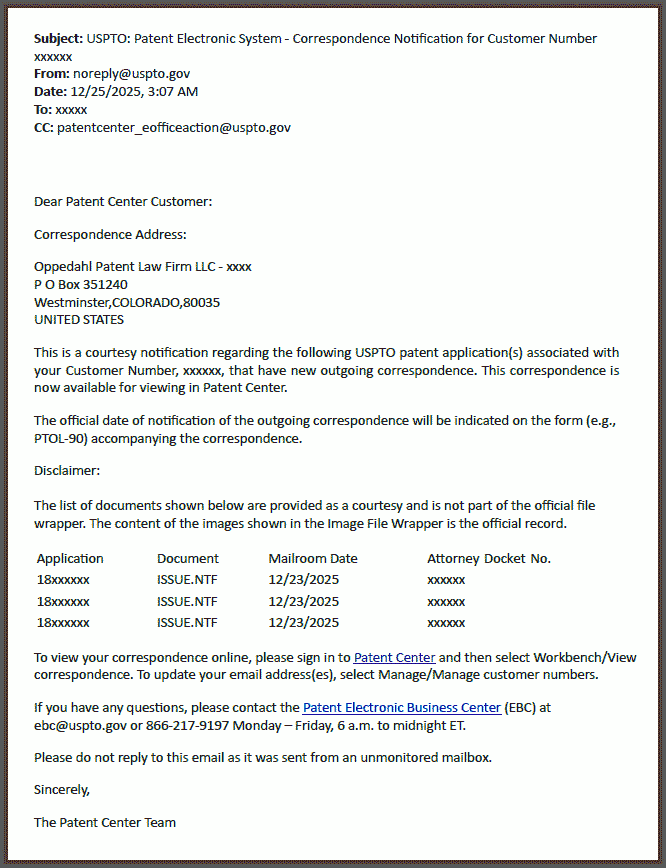
Oppedahl Patent Law Firm LLC (“OPLF”) sponsors many listservs (email discussion groups for intellectual property professionals, here is a list of them), some with over a thousand members.   In recent days, hundreds of members of the listservs have started to receive email messages that prompted questions, such as:

I received an email, and I need to know whether it is a phishing hack.  If it’s legitimate, I will respond accordingly.

Another listserv member responded:

Got same thing yesterday.  Is real.  The question is why.

What do these emails mean?  Why are the listserv members receiving the emails?  How should listserv members respond?  In this blog posting, I try to answer these questions.  Continue reading “Should the listserv member click on the link? Is it spearphishing?”

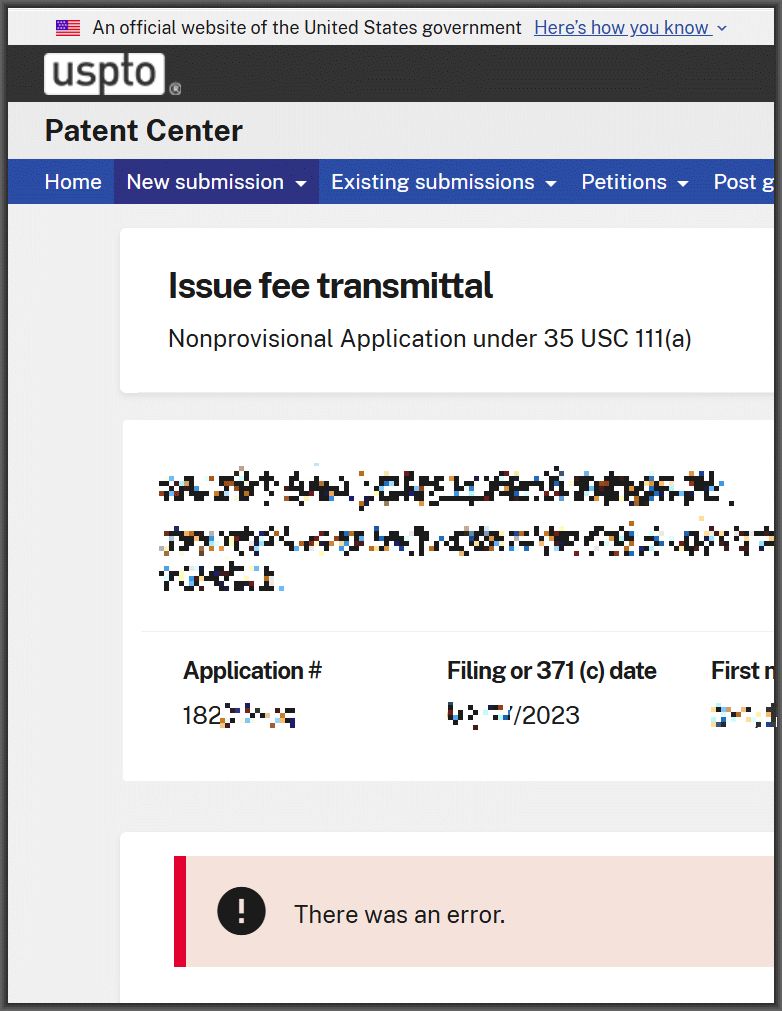
USPTO’s Patent Center says: “There was an error”

there was an error
click to enlarge

I was paying an Issue Fee in Patent Center, I clicked “submit”, and at right you can see what happened next.  “There was an error”.

That’s it. The developers of Patent Center want me to know that “There was an error.”

Well, now I know. There was an error.

What really deserves comment here is the state of mind of the developers when they designed this error message. Somebody somewhere at the USPTO, when they were coding this line of code, said “well, I guess I need to choose the text of this error message.”  And this person decided that the way to explain what had gone wrong was to use these four words.

You could ask a twelve-year-old child “is this an acceptable error message?” and the child would say “no it is not”.  Continue reading “USPTO’s Patent Center says: “There was an error””

Listservs seem to be back in service

Hello listserv colleagues!  I think the listservs are more or less back in service.  But for about 30% of our listserv members, the member’s email service provider (ESP) is blocking our postings as spam.  If you are in that 30%, I urge you to direct your ESP to stop the blocking.  This may include whitelisting the new IP address or speaking frankly with your ESP.

And if you posted anything to any of the listservs since about December 21, I am sorry to say you will probably need to repost it.

It took a lot of my professional time to deal with this.  And the hosting service will cost a bit more in perpetuity.  I will gladly receive donations to help support this, as detailed below.

Details follow.  Continue reading “Listservs seem to be back in service”

Which commercial e-signature platforms does the USPTO recognize?

an e-signatureOn March 22, 2024 the USPTO published a Federal Register Notice saying that the USPTO would start accepting electronic signatures generated by some commercial e-signature platforms without any requirement that virgules (forward slashes) be incorporated into the e-signature.  You can see, at right, an e-signature generated by one particular commercial e-signature platform.  If you were to e-file the document quoted at right, would the USPTO bounce it or accept it?  In this blog article I discuss in detail the various USPTO communications to try to work out the answer.  Spoiler alert — it turns out to be impossible to know what the USPTO will and will not accept.  Bigger spoiler alert — one assumes that TYFNIL this will be a fertile area for summary judgment practice and the like.  Continue reading “Which commercial e-signature platforms does the USPTO recognize?”

27 hours from now – USPTO discusses Section 101

27 hours from now, the USPTO will present a one-hour webinar discussing rejections under Section 101.  For more information, or to register for the webinar, click here.

Yes, we get 27 hours of advance notice for this event.

I do plan to attend.

I imagine that the presenters will be very, very dry, carefully avoiding doing or saying anything that could possibly extend beyond reading aloud, nearly word for word, from their presentation slides.

And I imagine the presentation slides will have been carefully crafted to do absolutely nothing beyond literal quotations from the source documents.

The chief source documents, as you know, are:

I have cited these two documents in quite a few responses to Office Actions in recent weeks, and in response, the Examiners have gone out of their way to ignore these two citations and to maintain their 101 rejections.

I predict that not one word will be uttered that extends beyond what one could already have learned simply by reading the source documents.  Nonetheless the fact that the event is taking place will surely count as a sort of signal to the patent community that USPTO leadership wants to influence the course of examination under Section 101.

One hopes that a similar webinar is being presented to the Examining Corps.