
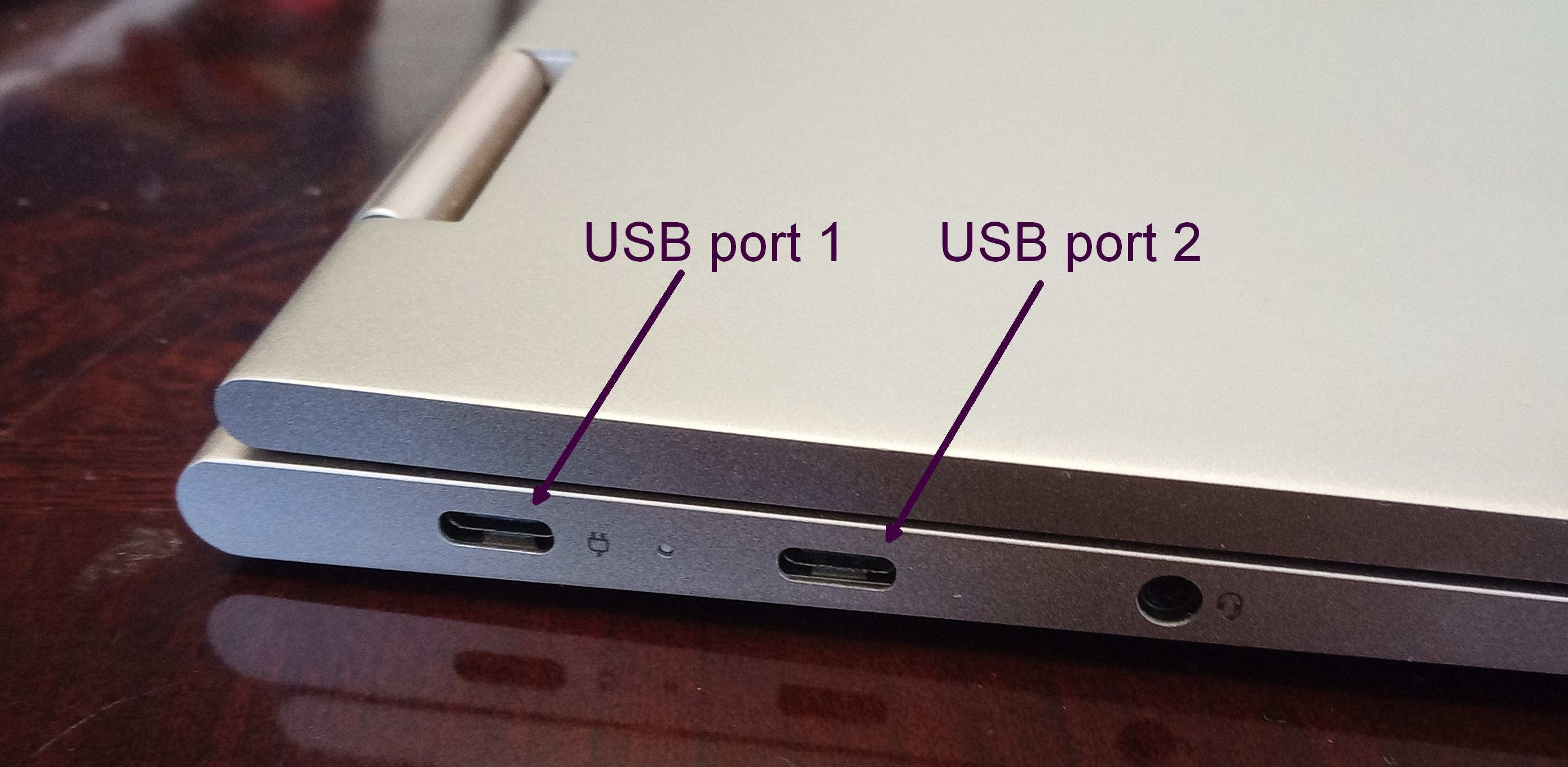
Most readers of my blog will recall my blog article dated March 2, 2020 entitled Charging port redundancy. The article talked about how nice it is if a maker of a notebook computer would set it up so that you could use any of a wide range of charging adapters, made by a wide range of manufacturers. You would not be stuck having to purchase multiples of some proprietary-plug adapter to match a proprietary connector on a notebook computer.
That’s the good news. The bad news is that the USB-C “power delivery” port on a notebook computer is fragile. It wears out. The miniscule connector pins in the USB-C port are only just barely up to the task of carrying the five or six amperes of charging current. Every time the charging plug gets bumped or jiggled, there is a bit of flex imposed upon the fragile surface-mount solder connections for the port. This blog article describes a way to try to deal with this fragility.
Yes, if any particular notebook computer has one such PD port, it will usually have two of them. This means that when (not if) one of the PD ports fails, as it very likely will during the service life of the computer, then the user can shift over to the use of the other PD port. The failed port, however, was not solely being used for charging. It was also important for many other purposes such as high-speed data transmission, and for dongles for ethernet or HDMI or audio headset or rodent such as a computer mouse.

So how may one try to deal with the fragility of the PD ports? Here is one answer at right. Below is a video showing the product in use:
The product, which you may see here on Amazon, has a male part that fits into the USB-C port on the computer, and has a matching female part that fits onto the male end of the cable that you might have been tempted to plug into the USB-C port on the computer. The two parts snap together with magnetism.
One way to talk about why this product is probably a smart idea is that if somebody were to bump the plug, the result is not any damage to the USB-C port on the computer. Instead, the result is that the plug detaches in a harmless way from the computer.
Another way to talk about why this product is probably a smart idea is that if something were to get “worn out”, it would very likely be in the product connectors rather than the connector in the computer. Meaning that if a connector were to get worn out, you could just replace the worn-out product connector.
USB-C ports have become so ubiquitous, but their fragility is a real issue. The convenience of using the same port for both charging and data is huge, but like you said, when one port fails, it’s not just an inconvenience for charging—it’s a loss of several important features. I’m curious if there are any long-term solutions for making these ports more robust.