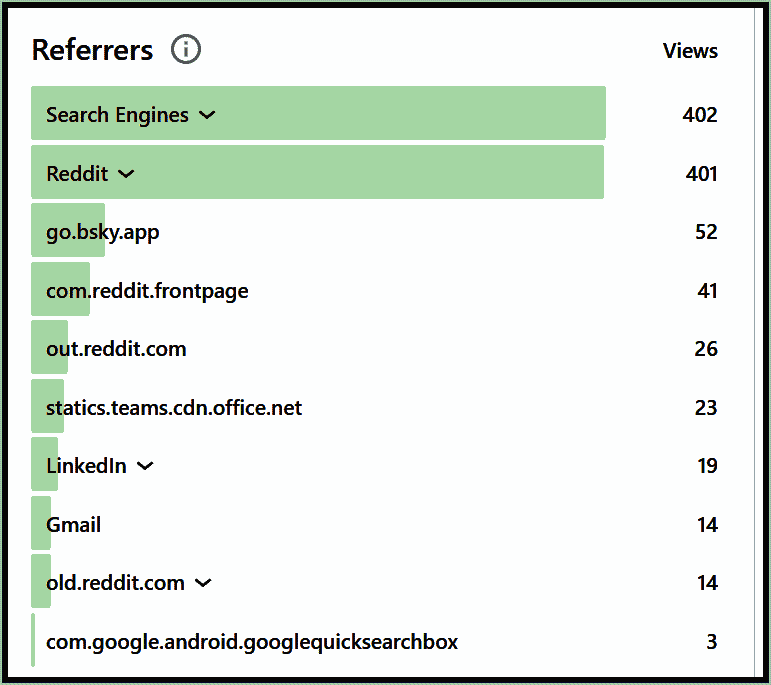
I find it interesting that nowadays, a lot of my blog traffic comes from Reddit. Continue reading “Where my blog traffic comes from?”

Bluesky: @oppedahl.com
I find it interesting that nowadays, a lot of my blog traffic comes from Reddit. Continue reading “Where my blog traffic comes from?”
For more than thirty years I have sponsored The Listservs. Each listserv is an email discussion group. I have sponsored listservs for patent practitioners, for trademark practitioners, and for industrial design protection practitioners. I have sponsored listservs for users of the Patent Cooperation Treaty and for users of Patent Center. And today, Google cut off 48 members of the e-Trademarks listserv.
What is Google doing wrong and what can be done about it? Continue reading “Today, Google cut off another 48 members of the e-Trademarks listserv”
Two days ago I blogged (see blog article) about a hallucination on the USPTO’s new web site, namely the existence of a “provisional patent”. The web site said:
File a provisional patent
Now the USPTO has corrected the web site. Now the bullet point is:
File a provisional patent application
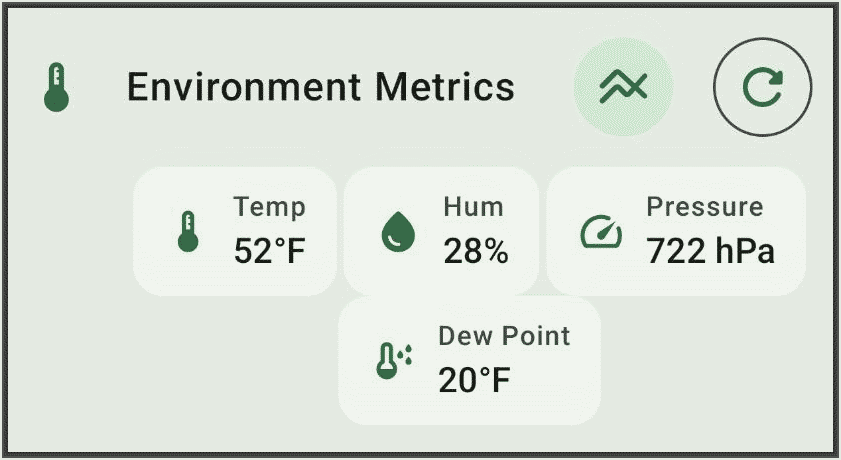
Recently I added an environmental sensor to a rooftop solar meshtastic node. This provides telemetry of temperature, humidity, and barometric pressure. In this article I describe what was required to accomplish this. Continue reading “Adding a barometric pressure sensor to a Meshtastic rooftop solar node”

(Update: two days after this blog posting, the USPTO corrected its hallucination. See blog post.)
There is no such thing as a “provisional patent”. Everyone knows this. Everyone except, it turns out, the United States Patent and Trademark Office. Continue reading “USPTO hallucinates the “provisional patent””
When I was first in practice, a long time ago, the only ways to communicate with a patent examiner at the USPTO were:
The USPTO’s policy, to the extent that such a thing had been thought about at all, was that all of these kinds of communication were sufficiently secure as to satisfy national security requirements. You might file a patent application the contents of which were so sensitive that a foreign filing licence would not be granted, and it was okay that the way you sent it to the USPTO was by postal service.
But what kinds of communication are actually secure? As I discuss below, the USPTO has this kind of thing absolutely backwards. What USPTO thinks is secure is not secure, and vice versa. Continue reading “What kinds of USPTO communications are secure and not secure?”
Recent news articles talk about instances where Anthropic’s Mythos AI is said to have found software flaws in pieces of software that have been around for a long time. The pieces of software in which Mythos has been said to have found flaws were each from the open-source community.
What should we, as readers and users of software, make of this? What should we do differently? Should we avoid open-source software? In this blog article I offer my thoughts. I do think there are things that we, as readers and users of software, should do and not do. But avoiding open-source software is not among them. Continue reading “What to make of the threats from AI that jeopardize software that we all rely upon?”
 I must confess I was not aware, until a few moments ago, that there was such a thing as a World Quantum Day.
You can see the Wikipedia page about World Quantum Day.
You can see a nice video with some fun facts about quantum physics.
Two USPTO people need to be retrained, and I don’t know their names. I don’t even know how to reach the supervisor of either of those USPTO people. In the old days, I would just drop an email to Kevin Little and he would straighten out this kind of problem. But he is gone and I don’t know who the new person is who does the job that he used to do.
I am hoping this blog article might reach an appropriate person at the USPTO, who could get in touch with me and could help with getting the two USPTO people retrained. And, the place in our application file where one of the people made a mistake, maybe this person could get the mistake corrected in our application file.
Here is the background and here are the details. Continue reading “Two USPTO people need to be retrained, and I don’t know their names”
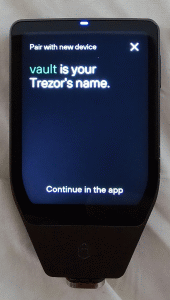 As any experienced trademark practitioner will tell you, it is a big mistake to use a trademark as a noun. Using a trademark as a noun (e.g., “Pass me a Kleenex”) instead of an adjective (e.g., “Pass me a Kleenex tissue”) risks transforming a brand name into a generic term, potentially leading to a loss of legal protection. I have contacted Trezor Company s.r.o. (the maker of the cryptocurrency wallet shown at right) to suggest that they stop making this mistake. Let’s see if, some time soon, they update their firmware and apps and web site accordingly. Continue reading “Using a trademark as a noun”