
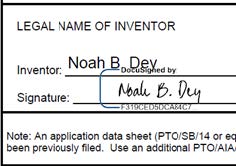
 On March 22, 2024 the USPTO published a Federal Register Notice saying that the USPTO would start accepting electronic signatures generated by some commercial e-signature platforms without any requirement that virgules (forward slashes) be incorporated into the e-signature. You can see, at right, an e-signature generated by one particular commercial e-signature platform. If you were to e-file the document quoted at right, would the USPTO bounce it or accept it? In this blog article I discuss in detail the various USPTO communications to try to work out the answer. Spoiler alert — it turns out to be impossible to know what the USPTO will and will not accept. Bigger spoiler alert — one assumes that TYFNIL this will be a fertile area for summary judgment practice and the like.
It is recalled that prior to September 21, 2004, the only signature USPTO was willing to recognize was a legacy handwritten pen-and-ink signature. In 2004 the USPTO carried out a rulemaking (69 FR 56481) that took effect on September 21, 2004. The rulemaking amended 37 CFR § 1.4 (“Rule 4”) to add a second permitted kind of signature namely the virgule (“forward slash”) signature. In this amendment to Rule 4, the USPTO defined the term “S-signature” to mean a signature incorporating the crucial virgules.
Our next step in this analysis is a USPTO document dated June 9, 2020, which labored to squeeze the crucial virgules (forward slashes) of an “S-signature” into a “DocuSign®” software signature. See USPTO quietly decides to accept more kinds of e-signatures, July 19, 2020. This approach to an attempt to allow use of “DocuSign®” software with an embedded virgule signature (thus complying with the then-controlling version of 37 CFR § 1.4(d)) was presumably an abject failure, because it put USPTO clerks into the position of having to pull out a magnifying glass to see whether the crucially important virgules of an S-signature had or had not been hand-drawn into the human signature of the “DocuSign®” software signature.
And so things festered for a decade. Then on March 22, 2024 the USPTO amended 37 CFR § 1.4(d) in this Federal Register Notice. The Notice reminds us that until now, the permitted signatures were:
-
-
- an old-fashioned “wet” or ink signature;
- a virgule signature (which USPTO calls an “s” signature) meaning some characters surrounded by virgules (forward slashes); and
- image-based versions of the two above kinds of signature.
-
The Notice explains that until now, on the trademark side, the USPTO has for some time been recognizing signatures generated using commercial e-signature platforms such as “DocuSign®” and “Acrobat® Sign”, in which no burden was imposed upon the would-be signer to embed the crucial virgules (forward slashes) of Rule 4 into the software e-signatures. (Rule 4 only applies to patent documents, not trademark documents.) The news in this Notice is that now the patent side of the USPTO will apparently try to act consistently with the trademark side, accepting e-signatures from some commercial e-signature platforms as well, without any requirement that the previously-crucial virgules of an “S-signature” be inserted.
The natural next step is to scroll down through the Notice to find the place where the USPTO formally states which commercial e-signatures the USPTO will accept (without the virgules) and which e-signatures the USPTO will not accept (except with virgules). Here, and I am not making this up, is the language that the Notice states:
37 CFR § 1.4(d)(4). Additional electronic signatures. Correspondence being filed in the USPTO for a patent application, patent, or other patent proceeding at the USPTO which requires a signature may be signed using an electronic signature that is personally entered by the person named as the signer and of a form specified by the Director.
(Emphasis added.) So if you want to know whether or not some particular form of e-signature will be accepted (without a required set of inserted virgules), the way to find out is to look to see whether the Director has “specified” that form.
The Notice carefully avoids ever actually saying that “DocuSign®” or “Acrobat® Sign” e-signatures lacking the previously crucial virgules are or not “specified by the Director” or will or will not be considered valid.
You can look and look through the Notice and you will never learn what kind of commercial e-signature the USPTO will accept. The only way to know is to find out, somehow, what the Director has “specified”. How may we learn this? For example can we assume that the place to look is the Official Gazette? Apparently not. Nowhere in the OG is this question answered, so far as I can find.
A treasure hunt on the web site of the USPTO does reveal a Memorandum dated March 22, 2024 (the same date as the date of the Notice) from the Deputy Commissioner for Patents to “all patent employees” that talks about the Notice. (Note that this Memorandum is not from the Director, but is from a person who is two steps down from the Director.) This Memorandum, which so far as I know has never been formally communicated to the customers of the USPTO, says that the Director has indeed “specified” some kinds of commercial e-signatures. Here is what the Memorandum says about what the Director has specified:
-
- The third-party signing software must be specifically designed to generate an electronic signature and the software must preserve signature data for later inspection in the form of a digital certificate, token, or audit trail. …
- The software must indicate that the signature page or electronic submission form was generated or electronically signed using document-signing software.
Note firstly that this Memorandum goes out of its way to carefully avoid saying whether “DocuSign®” and “Acrobat® Sign” e-signatures do or do not “indicate” as required by the Memorandum. Note secondly that this Memorandum goes out of its way to carefully avoid saying whether “DocuSign®” and “Acrobat® Sign” e-signatures do or do not “preserve” the required “digital certificate, token, or audit trail” as required by the Memorandum.
There are at least two layers to this analysis. A first layer is “how good does the purported commercial e-signature need to be to pass scrutiny by the USPTO clerk who reviews it?” But the mere fact that some clerk did not bounce some purported commercial e-signature surely is not binding upon the judge and jury who ten years later will be charged with the task of figuring out whether the purported e-signature does satisfy the “specification” from the Director.
So ten years from now in litigation (TYFNIL), the adversary seeking to invalidate a patent will have at least two lines of attack as to (for example) the purported signature of an inventor on an inventor’s declaration.
 Failure to “indicate” that the form “was … electronically signed using document-signing software.” Nowhere in this Memorandum does the writer make clear what this means. One can speculate that this calls for some (poorly defined) visual indication that software was used. I note that some “DocuSign®” e-signatures come out and say “DocuSigned by”. I note that some “Acrobat® Sign” e-signatures contain a red colored Acrobat logo such as is shown at right.
Maybe this is what “indicate” means. Who knows?
Failure to “preserve signature data for later inspection in the form of a digital certificate, token, or audit trail.” This strikes me as a fertile line of attack. TYFNIL, how is the patent owner going to prove that some particular purported e-signature did indeed give rise to a digital certificate or token or audit trail? I have to imagine that most patent owners would have no chance at all of overcoming such an attack. How would any particular patent owner know what exact software a particular inventor employed when e-signing an inventor’s declaration? How would the patent owner be able to show that any software at all was employed? Maybe the inventor simply pasted an image into the inventor’s declaration — an image that merely looks like the kind of thing that “DocuSign®” or “Acrobat® Sign” inserts onto a page.
For example look at the purported e-signature appearing at right. How do we know whether inventor Noah B. Dey did not simply paste that image onto the page, rather than paying for and using actual e-signing software from “DocuSign®”?
And even if the inventor Noah B. Dey did actually use some actual e-signing software, how could the patent owner possibly prove that the software actually did preserve the required “digital certificate, token, or audit trail”?
Again we remind ourselves that there are two layers to this analysis. The first layer is “what are the chances that any particular purported commercial e-signature will manage to avoid getting bounced by the USPTO clerk?” And the second layer is “what are the chances the patent owner will successfully defend against an attack TYFNIL?”
As for the first layer, we do actually have our answer. The answer may be found in a cryptic sentence in the middle of the Memorandum:
Patent examiners and other USPTO personnel may presume that the document-signing software preserves signature data for later inspection in the required form, unless the Office of the Deputy Commissioner for Patents (Legal) notifies the patent examiners or other USPTO personnel otherwise.
So I guess the practitioner or applicant that wants to know whether some particular kind of commercial e-signature software will get bounced need merely go on a treasure hunt (on the USPTO web site, we imagine) looking for a list of the “notifications” that the Office of the Deputy Commissioner for Patents (Legal) has sent to patent examiners or other USPTO personnel. One would then scroll through the list checking to see whether that particular commercial e-signature software is on the “notification” list and is thus not entitled to the “presumption” that the required “digital certificate, token, or audit trail” is indeed preserved as the Memorandum requires.
My best guess is that no USPTO clerk will ever bounce any purported commercial e-signature. Every USPTO clerk will simply look at the Memorandum (which is two pages in length) to see what it says. The closing sentence of the Memorandum (on page two) is:
Examples of proper and improper electronic signatures under the final rule are attached.
Regrettably, there is no page 3. No such examples are actually attached.
A further treasure hunt on the web site of the USPTO finds a separate PDF file captioned Signature Examples, 37 CFR 1.4(d)(4) effective March 22, 2024. One can speculate that this two-page PDF might or might not be the “examples of proper and improper electronic signatures” that were said to be “attached” to the Memorandum.
The two-page PDF gives four examples of a “proper” commercial e-signature. Two of the examples of a “proper” commercial e-signature say “DocuSigned by:” and the other two examples of a “proper” e-signature display an Acrobat logo as shown at right. So no matter how hard the USPTO tried to avoid openly endorsing any particular brand of commercial e-signing software in the Rule or in the Memorandum, in this “Signature Examples” document, the cat is out of the bag. And, after all, the original Notice did mention exactly those two brands of software, and no other, in its opening sentence. Here for convenient review is the opening sentence:
The United States Patent and Trademark Office (USPTO or Office) is revising the rules of practice in patent cases to update the signature rule to provide for the broader permissibility of electronic signatures using third-party document-signing software, such as DocuSign® and Acrobat® Sign, and more closely align signature requirements with the rules of practice in trademark cases.
(Emphasis added.) So if you want to be “sort of safe”, you must follow any of two paths:
-
- purchase and use one or another of the two USPTO-endorsed commercial e-signing platforms, namely DocuSign® or Acrobat® Sign, or
- use some other commercial e-signing platform that the USPTO did not endorse by name, and be prepared to litigate the question of whether the platform that you selected (that was not endorsed by name by the USPTO) does or does not “preserve signature data for later inspection in the form of a digital certificate, token, or audit trail.”
But to be really safe, as a patent applicant or practitioner, you must use the either of the two really safe kinds of signature:
-
- the “wet” ink signature, or
- the virgule signature.
With either of those two really safe kinds of signature, you will have denied your adversary the line of attack, at litigation time, that the signature failed to “preserve signature data for later inspection in the form of a digital certificate, token, or audit trail.”
What do you think? Are you prepared to rely upon a commercial e-signature despite not being able to prove, down the line, that it does “preserve signature data for later inspection in the form of a digital certificate, token, or audit trail”? Please post a comment below.
If a “virgule” signature is “safe,” but you want to use DocuSign® or Acrobat® Sign electronic signatures, why not simply insert a slash at the beginning and another slash at the end of each signature field before sending out an electronic signature package? That way, the electronic signature captured by the DocuSign® or Acrobat® Sign electronic signature software will appear between slashes.
Yes that is exactly what I wrote about in my blog article USPTO quietly decides to accept more kinds of e-signatures, July 19, 2020.
Carl, as you may know, DocuSign signatures include cryptographic layers, and you can click a signature to view its properties. Do you know if the USPTO perhaps drops all that information from the PDF file when storing it, only keeping the pixels (after the usual blurring)?
Your question is a very good one. So far as I know, the USPTO flattens the PDF file into a set of TIFF images, one per page.
Later if you click around in Patent Center with the idea of viewing a document in an application file, and if you download the document as a PDF, this PDF is created “on the fly” by stitching together the TIFF images for the various pages.
This discards any and all information of the kind that you describe. The sole exception would be a PDF that gets sent to SCORE. The usual way a document gets sent to SCORE is (a) it is a non-black-and-white drawing, or (b) it is a computer-readable genetic sequence listing.
You could check this yourself. Click around in Patent Center and look at some document that was signed using a software e-signature system. See if you can “click a signature to view its properties.” I predict that you will not be able to click the signature to view its properties. The sole exception being if the PDF file somehow got stored in SCORE.
Why would this be an issue TYFNIL? Even before § 115(h)(3), courts were reluctant to invalidate patents for an error on a declaration. It seems like a total non-issue now. I’m struggling to think of a form where it would matter (ADS, IDS, etc.). The only form that really carries any significance after a patent is issued is the assignment, which is not subject to these rules anway.
You ask “why would this be an issue TYFNIL?” The reason it would be an issue is that TYFNIL, the accused infringer will raise the issue. We are not talking about “an error on a declaration”. We are talking about a purported declaration which, at litigation time, will get questioned as to whether it was “signed”.
And then the patent owner just files a new one, curing the issue under § 115(h)(3).
At litigation time, the inventor may be dead, and thus unable to sign. Or may be uncooperative. The inventor may even be on the other side of the “v”.
Yes one could imagine trying to make use of substitute-statement practice during litigation. I cringe to imagine how many tens of thousands of dollars’ worth of summary judgment practice it would take to enable a substitute statement in a litigation.
Our clients love the convenience of DocuSign, so we use it extensively. We are careful to store the Certificate of Completion in our files to “preserve signature data for later inspection in the form of a digital certificate, token, or audit trail.” DocuSign does not email this to you by default – you either have to update your settings or download it manually.
But we’d prefer to not have to rely on the above so, as you have recommended, we still pre-populate virgules on either side of the space where an inventor will insert their name using DocuSign.