
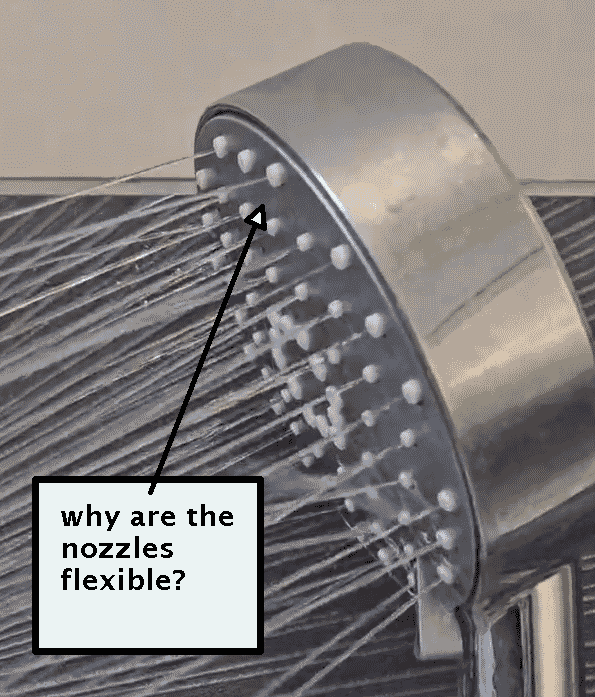
Over and over again I somehow stumble upon or learn about a thing that seemingly almost everybody else already knew. Today’s question is, why are shower head nozzles flexible? You probably already know why, in which case please post a comment below. Anyway, here is what I figured out about flexible shower head nozzles.
By now decades have passed during which I kept noticing that shower head nozzles tended to be made of some flexible material. The rest of the shower head would be made of solid material like metal or shiny hard plastic. But the nozzles, unaccountably, would be made of some very different and flexible material. Why? Is it to save money? Is it somehow more expensive to form and shape the nozzles if they are formed of the metal or hard plastic material? Does it somehow reduce the manufacturing cost to form the nozzles from flexible material and then to fit the nozzles into place?
(The alert reader probably already knows perfectly well why the nozzles are flexible, and that it has nothing to do with reducing the manufacturing cost. Indeed it probably adds a small amount to the manufacturing cost to go to the extra trouble to make the nozzles flexible.)
The answer is … scale. By “scale” we mean deposits of calcium carbonate or magnesium carbonate that accumulate in plumbing pipes and fixtures. This is due to “hardness” in the water. You can try to reduce this by installing a water softener, which uses an ion-exchange medium to capture most of the calcium and magnesium ions. Those ions are later flushed out with brine in a “recharge cycle”.
But even if you use a water softener, it is inevitable that some amount of scaling will happen. And you see it in the photograph above. A few of the nozzles, especially toward the bottom right in the photo, emit their water in some odd direction. This is due to scale that has accumulated in the nozzle.
Which now brings us to the answer of the original question. It turns out that the nozzles are flexible so that you can wiggle them around and dislodge the scale. The result for a previously clogged nozzle is that it will once again emit its water in a nice straight line, matching the neighboring nozzles. You can see this in the video recording above.
Dear reader, did you already know why the nozzles are flexible, before reading this blog article? If so, please post a comment below. On the other hand, if you share my sense of wonder as to the explanation, please share your thoughts below.
Fascinating!
Plumber taught that to me years ago
Due to my height challenges, I keep a shower squeegee in my shower not only to clean the glass, but to reach up and run it over the rain shower head to dislodge the scale. So yes, I knew this.
Whenever I see a stray nozzle I always wiggle it around and clean it out and I also use a brush to clean them out every now and then. It makes sense.
Yes, but only after similarly recognizing the same advantage—a design with functionality serving out the purpose intended by its designer.
Yep. Stumbled upon that myself a few years ago. I just flick them with a fingernail and they straighten up. If not, flick again.
yes, having cleaned them numerous times by wiggling around.
What is the patent number?
Yes. It says so on the instruction sheet.
Also discovered this when, after installing a new shower head, I actually read the instructions for some reason. It’s amazing what you can learn that way.
(I’m sure my DSLR camera also does cool tricks, but they remain buried in a 500+ page manual that I intend to read someday.)
The surprising thing is that the scale apparently does not stick to the polymer. Quite different from the behaviour seen on metal surfaces, I would say.
Yes – If you ever had to pass a kidney stone …
they are, in fact, flexible so that we may take part in the small, seasonal ritual by which the human user is invited to participate in the restoration of cosmic order.
a wiggle, here, a thumb-rub, there— the menacing water spray has righted its course and civilization reasserts itself over calcium carbonate. For a brief moment, standing there half-awake and annoyed, I am not just a consumer of plumbing infrastructure. I am its steward. Its healer. Its chosen one.