What happens so often is that the USPTO gets things wrong about the PCT process. For example the USPTO seems so often to go out of its way to avoid giving any credit, let alone full faith and credit, to the work done by the International Searching Authority when it searches and examines a patent application. So here is a refreshing example of the USPTO getting it right.
Where to send a USPTO patent petition?
(Note on November 10, 2025: alert reader Suzannah Sundby pointed out to me that at the present time there are at least two resources on the USPTO web site (here and here) about this general topic.)
In the old days (meaning, before e-filing at the USPTO became possible), the practitioner who was filing a petition would simply drop the petition in the mail, directed to the USPTO generally. Someone in the USPTO mail room would look at each petition, and would pick where exactly within the USPTO to direct the petition so that it might be considered and decided.
Then the Internet happened and a decade later, the USPTO reacted to the Internet by setting up EFS-Web. In EFS-Web the burden of figuring out where exactly within USPTO a patent-related petition would be directed got shifted away from USPTO mail room personnel and onto the e-filer. The choices from which the patent e-filer might pick include:
-
- Petition for review by the Office of Petitions
- Petition for review by the PCT legal office
- Petition for review by the Technology Center SPRE
When you are e-filing a petition, how should you pick where to send your petition?
I just learned about another IP blog …
It’s been around for some time, but I only learned about it the other day … the Brandaide blog. A blog that is all about creating, building, and protecting your brand.
A new category of walking-corpse US patents?
(Update: USPTO is doing a very customer-friendly thing about this, as I report here.)
One of the scariest things for a US patent practitioner is the thought of being held responsible for a patent that turns out to have been a “walking corpse”. A patent that everybody thought was a normal patent and it turns out that there is some defect that means it was never actually a patent at all.
My favorite category of “walking-corpse” patent had, until now, been the patent that was granted on a patent application in which the applicant made a non-publication request, and then did foreign filing, and failed to timely rescind the non-publication request. The rules say that such a patent application is deemed abandoned some 46 days after the foreign filing happened. But probably nobody involved at the time knew that the status of the application was “abandoned”. Not the Examiner, not the USPTO employee who cheerfully collected the Issue Fee and mailed out the ribbon copy of the granted patent. Least of all the practitioner who forgot about rescinding the non-pub request and who triumphantly handed the ribbon copy of the patent to the client. Likely as not, the first time this defect would get noticed is at litigation time.
Anyway until now that was my favorite example of a “walking corpse” US patent. But it looks like maybe there’s now a new category of walking-corpse US patents. Continue reading “A new category of walking-corpse US patents?”
MTB XI – the photographs
Last night was Meet the Bloggers XI. Yes, the eleventh annual reception. Henry’s Pub, the same restaurant in San Diego where the first and original Meet the Bloggers took place ten years ago, was closed to the public for the night for this special event.  In this exterior shot of the restaurant you can see maybe half of the people who attended this reception.
 In this shot you can see Erik Pelton giving out some of the door prizes.
“out of the office until May 8th”?
Send an email today to a trademark practitioner located anywhere in the world, and likely as not you will receive an automatic reply like this:
Hello. I am out of the office until May 8 with limited access to email. If this matter is urgent please contact my assistant so-and-so …
The reason, of course, is that the email recipient is in San Diego right now. As am I. If you are in San Diego and want to see me this week, the best way to do it is to drop by one of these two receptions.
What I faxed to Director Lee about the PPH petition backlog
Here is what I faxed today to USPTO Director Michelle Lee about the ever-increasing backlog of PPH petitions.
Continue reading “What I faxed to Director Lee about the PPH petition backlog”
Using an RCD to try to defeat a US design patent?
A member of the industrial designs listserv asked:
In general can a Registered Community Design be cited as prior art to counter a claim of design patent infringement of an issued US design patent in the US? Do you know of a case that says that?
Here’s what I think. And I hope that readers will offer their own comments.
Continue reading “Using an RCD to try to defeat a US design patent?”
OTT (over-the-top) media programming is on the way
We will all be affected by the inevitable growth of OTT (over-the-top) distribution of entertainment, both as intellectual property practitioners serving clients and as consumers watching the stuff.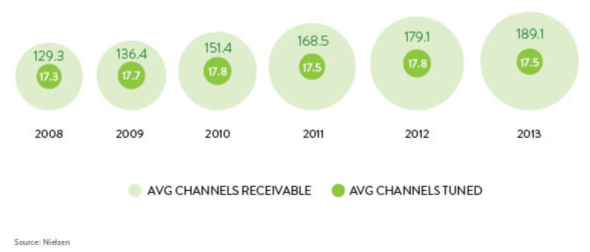
A Nielsen report from May of 2014 says that in 2013 the average American household got 189 channels from their cable television or satellite television provider, and actually watched only 17 channels. One way to look at this is that in 2013, the cable or satellite provider bundled about 112 channels that you didn’t want along with the 17 channels that you did want.
“Over-the-top” or OTT is the effort by some content providers to bypass the cable and satellite television providers and to reach consumers directly. I’ll discuss some of the OTT initiatives.
Continue reading “OTT (over-the-top) media programming is on the way”
How Madrid ten-year trademark renewals work
US trademark practitioners are just now starting to get asked by foreign clients to do a ki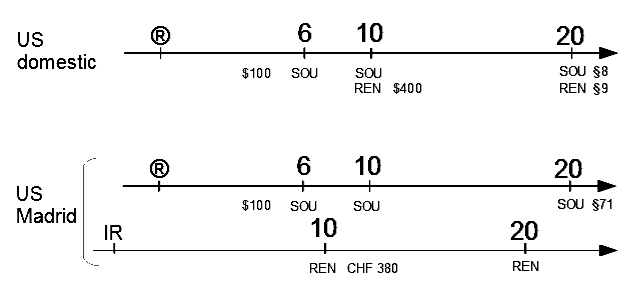 nd of filing that never existed before about September of 2014. The filing is a ten-year Statement of Use for a US Madrid registration. This blog article tries to explain such filings and how they are similar to and different from other US trademark maintenance and renewal filings. If you already understand everything about the figure at right, you can skip reading this blog article!
Continue reading “How Madrid ten-year trademark renewals work”