
Recently a colleague asked whether a second Hague application (international design application) can claim priority from a first Hague application. This is a very interesting question. The answer is yes, it can, under certain circumstances, as I will explain. Continue reading “Can a Hague application claim priority from a Hague application?”
Why would anyone convert a US provisional application to a non-provisional?
There is a procedure for converting a US provisional patent application into a non-provisional patent application. The practitioner who follows this procedure (instead of simply filing a non-provisional with a domestic benefit claim) will put the client in the position of incurring an extra government fee and losing some patent term.
So why would anyone ever carry out this procedure? There is a real-life situation where this might be the clever thing to do, as I learned the other day from a smart member of the EFS-Web listserv.
Continue reading “Why would anyone convert a US provisional application to a non-provisional?”
PDX and DAS on Tuesday
Attend a webinar this coming Tuesday, June 19th. The subject is PDX and DAS. Or maybe you do not need to attend, because you already have mastery of PDX and DAS! Those who have mastery of PDX and DAS should have no problem passing this DAS quiz. Continue reading “PDX and DAS on Tuesday”
See if you can pass a simple quiz on the DAS system
Here’s a simple quiz about the DAS system. Pass this quiz and it means you know quite a bit about DAS. Continue reading “See if you can pass a simple quiz on the DAS system”
A smart thing that USPTO customers should do now
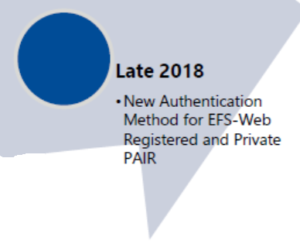 (Please also see a followup blog article here.)
Those who make use of Private PAIR and EFS-Web are accustomed to USPTO’s very clunky way of accomplishing two-factor authentication, namely the poorly designed Entrust Java Applet (EJA). USPTO has now formally announced (see excerpt at right from a slide in a USPTO webinar yesterday) that it will replace EJA with a much more user-friendly approach. The goals of today’s blog article are:
- describe the new system, and
- explain what you can do right now to be ready for it well in advance.
Continue reading “A smart thing that USPTO customers should do now”
Danish patent office is now an Accessing Office in DAS
 The list of Accessing Offices in the DAS system continues to grow. As I blogged on May 26, 2018, the Danish Patent and Trademark Office (DKPTO) had announced that it would soon become an Accessing Office in the DAS system. Today is the day! As of today, DKPTO is an Accessing Office in DAS. Continue reading “Danish patent office is now an Accessing Office in DAS”
Reprise of PDX-DAS webinar
The May 8, 2018 webinar on this topic was well received. But many people missed the webinar and asked if it will be repeated. So we are presenting this webinar again, with updates. For example:
- On June 1, 2018 the Denmark patent office will become an Accessing Office in the DAS system
- On June 1, 2018 the Netherlands patent office will become a member of the DAS system
This will be a live webinar, not a replay of a recording. Continue reading “Reprise of PDX-DAS webinar”
Design Day 2018 – all slides now posted
A design electronic priority document experiment to try
At the present moment the number of Offices participating in DAS as depositing Offices is quite small. So far as I am aware the list of design depositing Offices is limited to China, Spain, and India. But a little-known feature of DAS permits design practitioners to be really smart about electronic certified copies. Continue reading “A design electronic priority document experiment to try”
DAS membership and participation developments
It has been announced that on June 1, 2018, the Netherlands Patent Office will join the DAS system. This is of course welcome news, and this will bring the number of DAS participating Offices to 18.
Among the IP5, conspicuously absent from DAS is the European Patent Office. EPO has promised that it will join DAS by late 2018.
Among the ID5, conspicuously absent from DAS is the European Union Intellectual Property Office. It is hoped that EUIPO will join DAS soon.
With regard to the USPTO, the PDX system provides some of the same functions as DAS. If between some pair of Offices (for example US and CN or US and KR) there is both a PDX relationship and a DAS relationship, the PDX relationship trumps. As between DAS and PDX, DAS is to be preferred. It permits more effective troubleshooting by the practitioner and it is more secure. Thus it is hoped that USPTO will soon pull the plug on its PDX relationships with CN and KR, thus permitting DAS to be employed instead.
It is hoped that more and more Offices will participate in DAS with respect to design applications. USPTO has indicated that it will commence participation in DAS as a depositing Office for designs Real Soon Now.